
Independent engineering spreadsheet developed by East Coast Structural Engineering Consultant Pty. Ltd. The methodology is informed by established prestressed concrete material principles and applicable Australian Standards. Technical reference materials consulted during development include Prestressed Concrete by Robert Warner, Stephen Foster, Andrew Kilpatrick and Rebecca Gravina. This spreadsheet is independently developed and is not affiliated with, endorsed by or published by the textbook authors or publisher.
This excels sheets introduces the fundamental material properties that govern the behaviour and performance of prestressed concrete structures. The Excel spreadsheets automate the calculation of concrete and prestressing steel properties, helping users understand how material characteristics influence stresses, strength, serviceability, and long-term structural performance.
Included Excel Examples:
✅ Calculation of concrete compressive and tensile strength properties
✅ Modulus of elasticity of concrete
✅ Stress-strain relationships for concrete
✅ Time-dependent concrete behaviour
✅ Creep coefficient calculations
✅ Shrinkage strain calculations
✅ Prestressing steel stress-strain behaviour
✅ Relaxation characteristics of prestressing tendons
✅ High-strength reinforcing steel properties
✅ Material factors used in design
✅ Evaluation of effective material properties over time
✅ Worked examples following Stephen Foster's design procedures
Independent engineering spreadsheet developed by East Coast Structural Engineering Consultant Pty. Ltd. The methodology is informed by established prestressed concrete material principles and applicable Australian Standards. Technical reference materials consulted during development include Prestressed Concrete by Robert Warner, Stephen Foster, Andrew Kilpatrick and Rebecca Gravina. This spreadsheet is independently developed and is not affiliated with, endorsed by or published by the textbook authors or publisher.
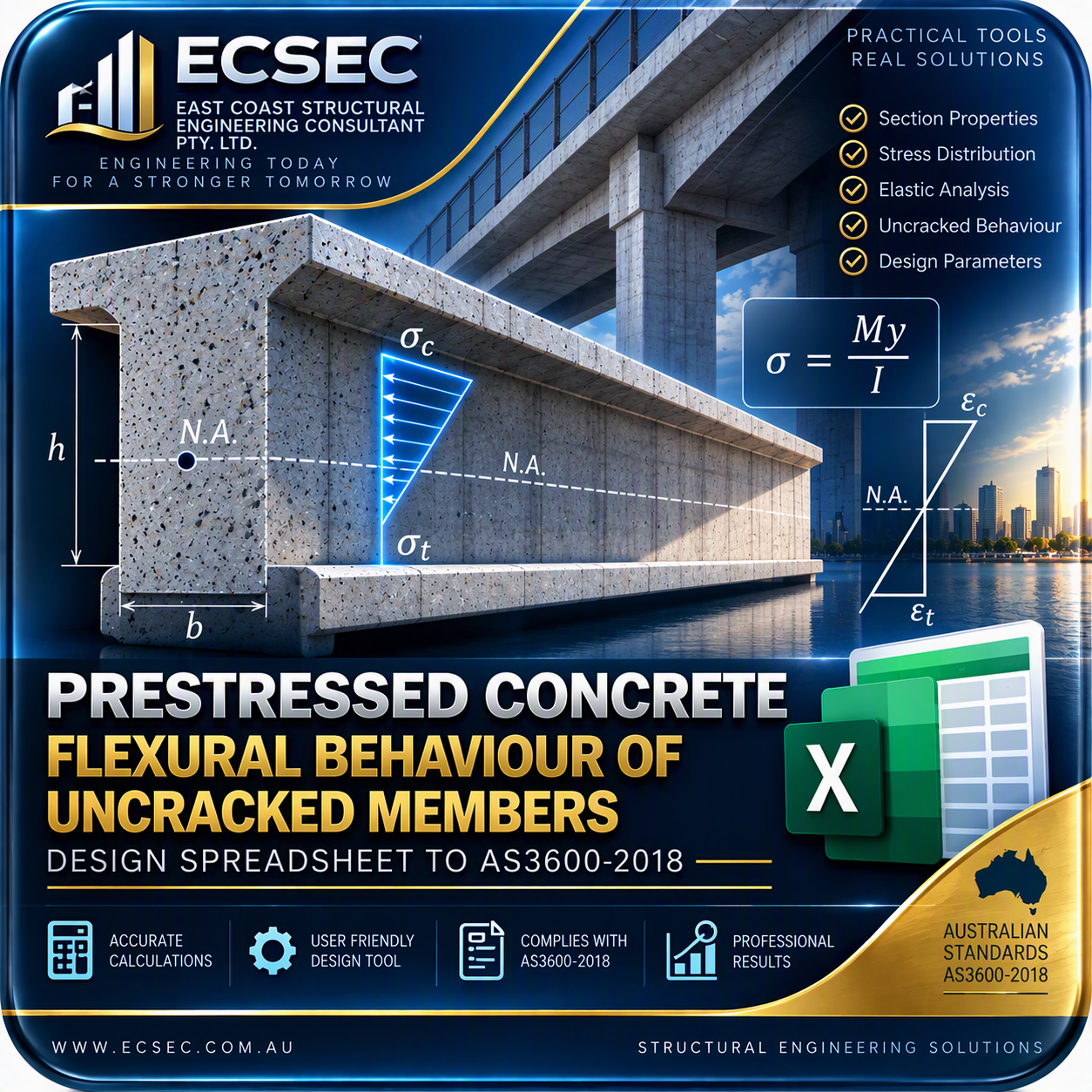
This excels sheets focuses on the flexural response of prestressed concrete members that remain uncracked under service loading. The Excel spreadsheets automate the calculation of stresses, section properties, and bending behaviour, enabling users to understand how prestressing influences structural performance before cracking occurs.
Included Excel Examples:
✅ Stress distribution due to prestressing force and eccentricity
✅ Combined effects of prestress and external loads
✅ Calculation of section properties and kern distances
✅ Extreme fibre stresses at transfer and service stages
✅ Determination of cracking moments
✅ Load-balancing concept and equivalent prestressing loads
✅ Serviceability stress verification
✅ Assessment of tension-free sections
✅ Worked examples based on textbook design procedures
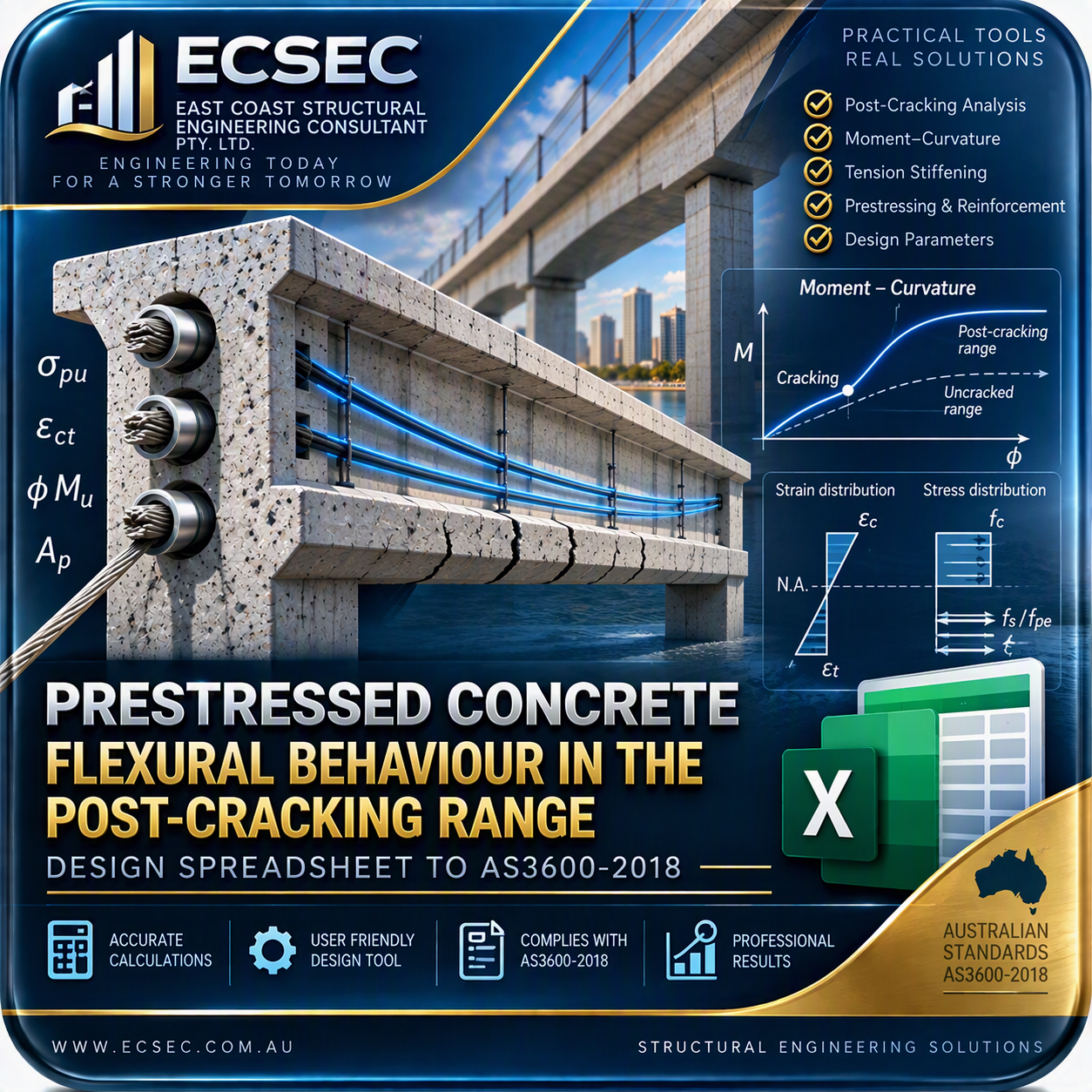
Prestressed Concrete - Flexural behaviour in the post-cracking range
This excels sheets explores the behaviour of prestressed concrete members after cracking has occurred and as loads increase towards ultimate strength. The accompanying Excel spreadsheets automate the analysis of cracked sections, enabling users to evaluate strain distributions, tendon stresses, flexural capacity, and failure mechanisms using practical design procedures from Stephen Foster's Prestressed Concrete textbook.
✅ Cracked section analysis of prestressed concrete members
✅ Location of the neutral axis in cracked sections
✅ Strain compatibility analysis
✅ Stress calculations in concrete, prestressing tendons, and reinforcement
✅ Bonded tendon behaviour at ultimate load
✅ Unbonded tendon stress development
✅ Ultimate moment capacity calculations
✅ Effects of prestressing steel ratio on strength
✅ Reinforcement contribution to flexural resistance
✅ Ductility assessment of prestressed members
✅ Comparison of under-reinforced and over-reinforced sections
✅ Prediction of flexural failure modes
✅ Complete worked design examples based on textbook procedures
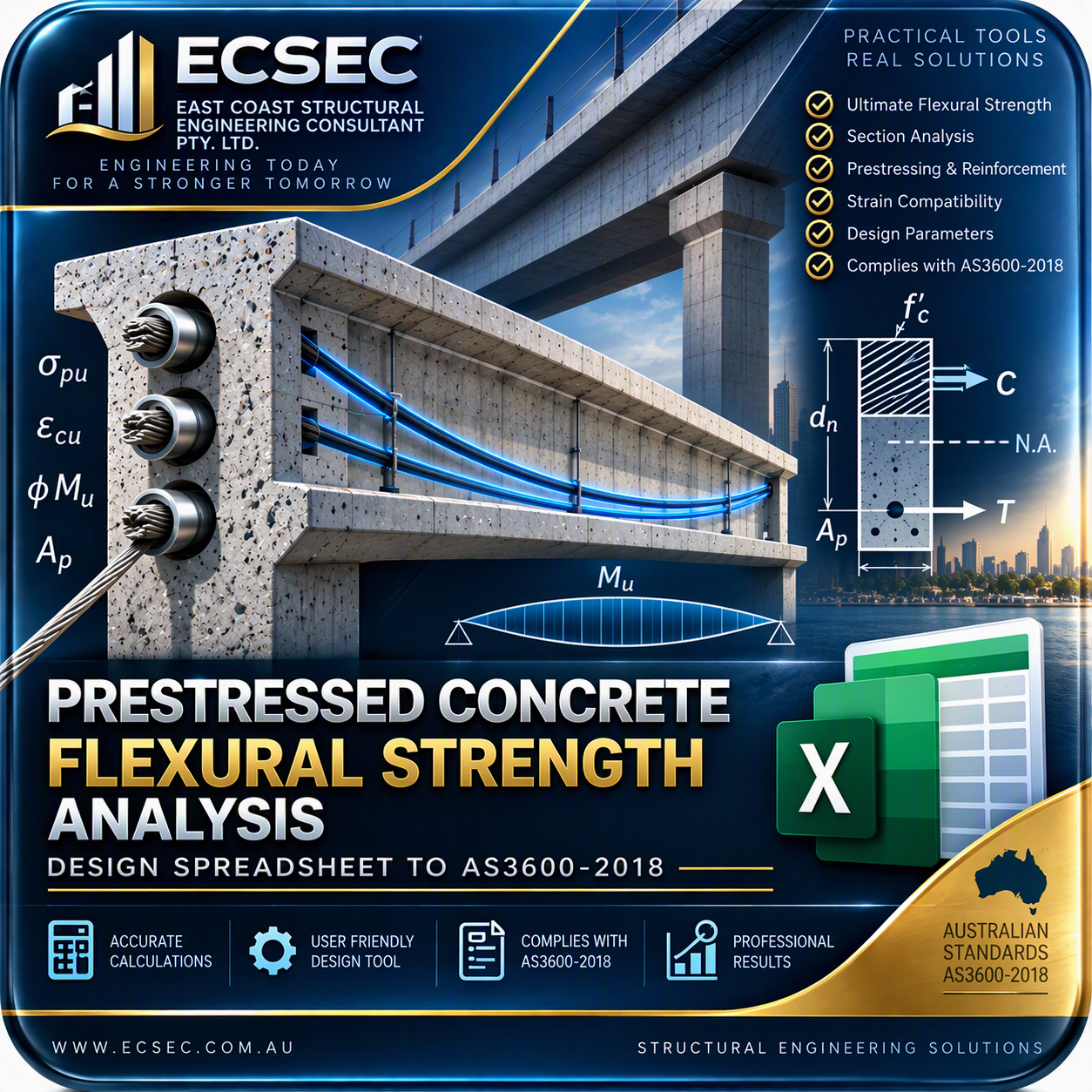
Prestressed Concrete - Flexural strength analysis
This excels sheets examines the behaviour of prestressed concrete members after cracking has occurred and focuses on the structural response as loads approach ultimate capacity. The Excel spreadsheets automate the complex calculations associated with cracked section analysis, allowing users to evaluate strength, ductility, stress development, and failure mechanisms efficiently.
Included Excel Examples:
✅ Cracked section analysis
✅ Determination of neutral axis depth after cracking
✅ Strain compatibility calculations
✅ Stress distribution in concrete and prestressing steel
✅ Evaluation of tendon stress at ultimate load
✅ Ultimate moment capacity calculations
✅ Bonded and unbonded tendon behaviour
✅ Reinforcement contribution to flexural capacity
✅ Load-deflection behaviour after cracking
✅ Ductility assessment of prestressed members
✅ Identification of flexural failure modes
✅ Worked examples based on Stephen Foster's design procedures
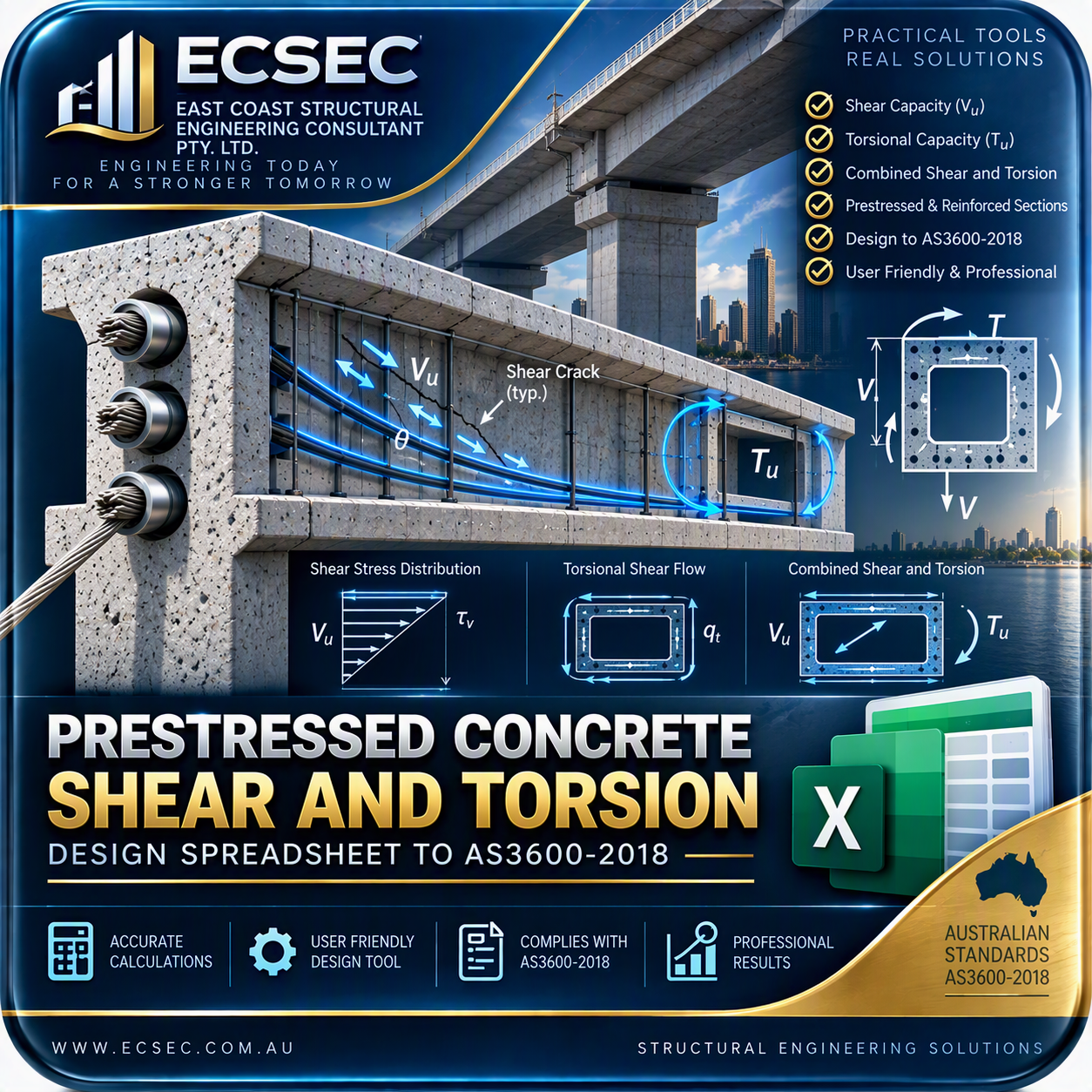
Prestressed Concrete - Shear and torsion
This excels sheets examines the behaviour and design of prestressed concrete members subjected to shear forces and torsional moments. The Excel spreadsheets automate the complex calculations associated with ultimate limit state design, enabling users to evaluate shear capacity, torsional resistance, cracking behaviour, and reinforcement requirements efficiently and accurately.
✅ Shear stress distribution in prestressed concrete members
✅ Influence of prestressing on shear resistance
✅ Principal tensile stress calculations
✅ Web-shear cracking assessment
✅ Flexural-shear cracking assessment
✅ Shear capacity of concrete sections
✅ Shear reinforcement design (stirrups)
✅ Ultimate shear strength verification
✅ Torsional stress calculations
✅ Torsional cracking moment determination
✅ Combined shear and torsion design
✅ Interaction between shear, torsion, and bending
✅ Design of transverse reinforcement for torsion
✅ Practical beam design examples
✅ Step-by-step worked solutions based on Stephen Foster's textbook procedures

Prestressed Concrete - Anchorage
This excels sheets focuses on the design and behaviour of anchorage zones in prestressed concrete members. The Excel spreadsheets automate the calculations associated with concentrated prestressing forces, helping engineers evaluate bursting stresses, spalling stresses, anchorage reinforcement, and end-block behaviour. These practical examples illustrate how prestressing forces are safely transferred from the tendon anchorage into the concrete member.
✅ Anchorage zone stress analysis
✅ Load transfer from anchorages into concrete
✅ End-block force distribution
✅ Bursting force calculations
✅ Spalling force calculations
✅ Anchorage reinforcement design
✅ Local zone and general zone analysis
✅ End-block design for post-tensioned members
✅ Stress trajectories in anchorage regions
✅ Reinforcement detailing requirements
✅ Verification of anchorage zone capacity
✅ Design examples for post-tensioned beams and slabs
✅ Step-by-step worked examples based on Stephen Foster's design procedures
Transform prestressed concrete theory into practical engineering calculations with this comprehensive collection of professionally developed Excel spreadsheets, this workbook package automates key design procedures, worked examples, and engineering calculations commonly encountered in university studies and professional practice.
The spreadsheets provide transparent formulas, editable inputs, and step-by-step solutions, enabling users to learn fundamental concepts while significantly reducing manual calculation time.
Develop a solid understanding of the concrete and steel properties that form the foundation of prestressed concrete design. Automated examples cover material strength, modulus of elasticity, creep, shrinkage, relaxation, and stress-strain relationships.
Excel Examples Include:
Concrete material properties
Prestressing steel properties
Modulus of elasticity calculations
Creep and shrinkage effects
Relaxation of prestressing tendons
Time-dependent material behaviour
Learn how prestressing forces influence structural behaviour at transfer and service stages. The spreadsheets automate stress calculations, tendon eccentricity effects, and equivalent load analysis.
Excel Examples Include:
Prestress force calculations
Tendon eccentricity effects
Equivalent load method
Stress distribution calculations
Section property analysis
Transfer and service condition assessment
Examine the flexural response of prestressed concrete members before cracking occurs. Examples illustrate stress distributions, cracking moments, and serviceability performance.
Excel Examples Include:
Extreme fibre stress calculations
Combined prestress and load effects
Cracking moment determination
Service stress verification
Kern distance calculations
Load-balancing analysis
Explore how prestressed concrete members behave after cracking and as loads increase toward ultimate conditions. Automated examples simplify cracked-section analysis and stress redistribution.
Excel Examples Include:
Cracked section analysis
Neutral axis determination
Strain compatibility calculations
Tendon stress evaluation
Ductility assessment
Failure mode investigation
Master the ultimate strength design of prestressed concrete members using automated calculations based on force equilibrium and strain compatibility principles.
Excel Examples Include:
Ultimate moment capacity
Bonded tendon analysis
Unbonded tendon analysis
Neutral axis depth
Internal force equilibrium
Flexural strength verification
Gain practical experience in the design of prestressed members subjected to shear and torsional actions. The spreadsheets automate cracking checks, capacity calculations, and reinforcement design.
Excel Examples Include:
Web-shear cracking
Flexural-shear cracking
Shear resistance calculations
Stirrup design
Torsional strength assessment
Combined shear and torsion design
Understand the critical design principles governing anchorage zones and force transfer regions in prestressed concrete structures.
Excel Examples Include:
Bursting force calculations
Spalling force calculations
Anchorage zone analysis
End-block design
Reinforcement detailing
Local and general zone design
✅ Fully automated Excel design spreadsheets
✅ Step-by-step worked examples
✅ Transparent formulas for learning and verification
✅ Editable inputs for custom applications
✅ Suitable for university coursework and professional practice
✅ Developed by practicing structural engineers
✅ Based on Stephen Foster's internationally respected textbook
✅ Applicable to prestressed and post-tensioned concrete structures
Structural Engineering Students
Graduate Engineers
Design Engineers
Post-Tensioning Engineers
Consulting Structural Engineers
Bridge Engineers
Building and Infrastructure Designers
Master the analysis and design of prestressed concrete structures with this comprehensive Excel workbook package. The package contains professionally developed spreadsheets that automate the worked examples and design procedures.
Whether you are learning prestressed concrete for the first time or applying it to real-world projects, these spreadsheets provide practical tools for analysing prestress effects, flexural behaviour, ultimate strength, shear, torsion, and anchorage design.
Save hours of calculation time while gaining a deeper understanding of prestressed concrete behaviour and design.
Developed by ECSEC – East Coast Structural Engineering Consultant Pty Ltd.
No results match your search. Try removing a few filters.

