 Image 1 of 1
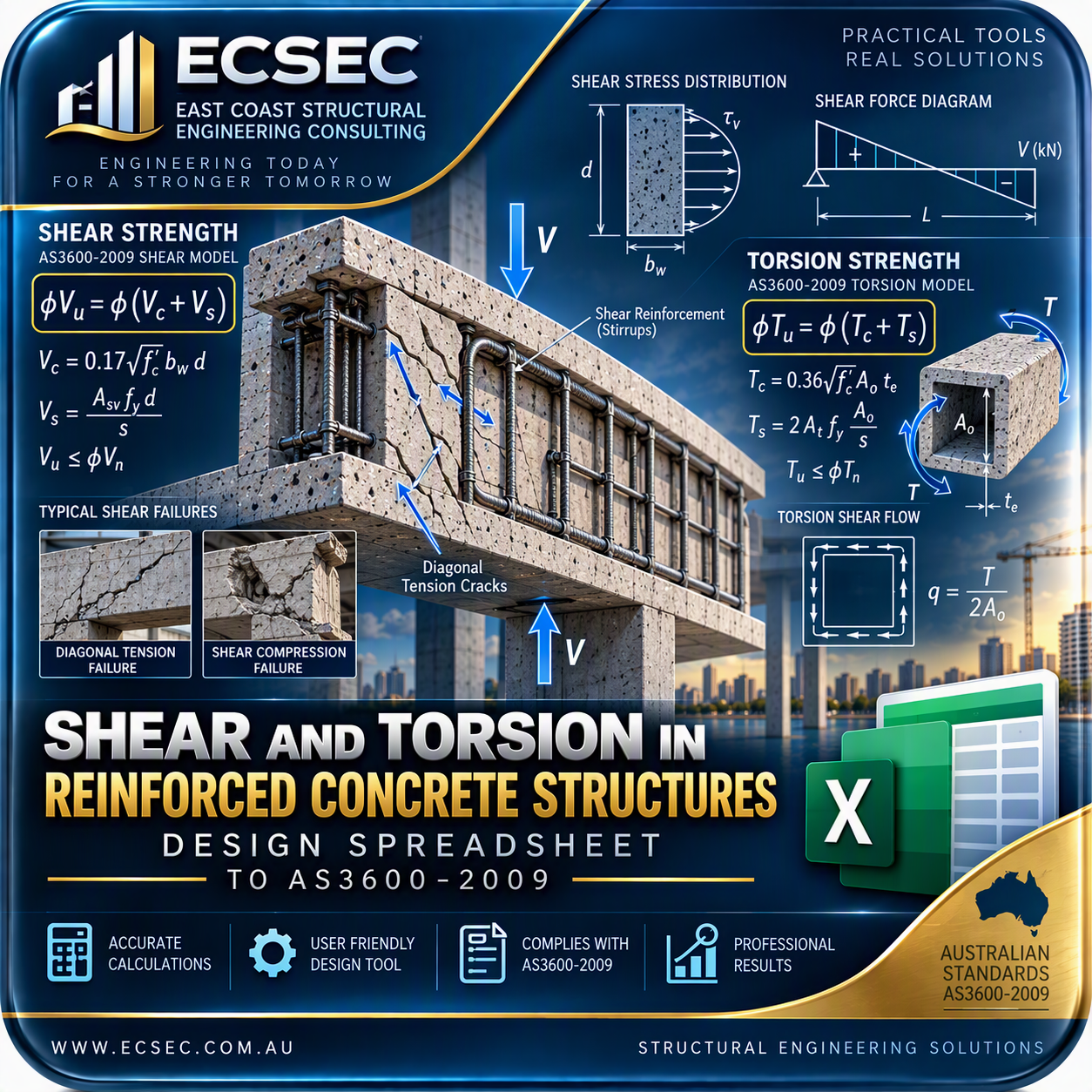
This chapter examines the design and behaviour of reinforced concrete members subjected to shear forces and torsional moments. The Excel spreadsheets automate the calculations required to determine shear capacity, torsional strength, and reinforcement requirements, providing engineers with practical tools to understand and apply reinforced concrete design principles.
✅ Shear stress calculations in reinforced concrete beams
✅ Concrete contribution to shear resistance
✅ Design shear force determination
✅ Ultimate shear capacity checks
✅ Minimum shear reinforcement requirements
✅ Stirrup design and spacing calculations
✅ Shear reinforcement detailing
✅ Deep beam shear considerations
✅ Torsional stress calculations
✅ Torsional cracking assessment
✅ Torsional strength calculations
✅ Combined bending, shear, and torsion analysis
✅ Closed stirrup and torsional reinforcement design
✅ Shear-torsion interaction verification
✅ Complete beam design worked examples
✅ Step-by-step examples.
Learn how reinforced concrete members resist shear forces and torsional moments with this collection of automated Excel spreadsheets.
This workbook chapter provides practical design tools that simplify the analysis of reinforced concrete beams subjected to shear and torsion. The spreadsheets automate the calculations required to determine concrete shear capacity, design stirrup reinforcement, evaluate torsional effects, and verify compliance with reinforced concrete design requirements.
The examples demonstrate the critical mechanisms governing shear and torsional behaviour and help engineers gain confidence in designing safe and economical reinforced concrete members.
Understand shear behaviour in reinforced concrete members
Calculate concrete shear capacity
Design and detail shear reinforcement
Determine torsional strength and cracking resistance
Analyse combined bending, shear, and torsion effects
Verify ultimate limit state requirements
Improve understanding of beam behaviour
Automate repetitive engineering calculations
✔ Fully automated Excel calculations
✔ Transparent formulas for learning and verification
✔ Editable spreadsheet inputs
✔ Step-by-step worked examples
✔ Suitable for university study and professional engineering practice
✔ Consistent with AS 3600 reinforced concrete design principles
✔ Developed by ECSEC Structural Engineering Consultants
Structural Engineering Students
Graduate Structural Engineers
Design Engineers
Consulting Structural Engineers
Engineers designing reinforced concrete buildings and infrastructure
Shear and torsion failures are often sudden and brittle, making their correct design essential for structural safety. A sound understanding of shear transfer mechanisms, stirrup design, and torsional resistance is critical for beams, transfer girders, edge beams, spandrel beams, retaining structures, and heavily loaded concrete elements.
Transform complex shear and torsion calculations into practical engineering solutions with professionally developed ECSEC Excel design tools.
This chapter examines the design and behaviour of reinforced concrete members subjected to shear forces and torsional moments. The Excel spreadsheets automate the calculations required to determine shear capacity, torsional strength, and reinforcement requirements, providing engineers with practical tools to understand and apply reinforced concrete design principles.
✅ Shear stress calculations in reinforced concrete beams
✅ Concrete contribution to shear resistance
✅ Design shear force determination
✅ Ultimate shear capacity checks
✅ Minimum shear reinforcement requirements
✅ Stirrup design and spacing calculations
✅ Shear reinforcement detailing
✅ Deep beam shear considerations
✅ Torsional stress calculations
✅ Torsional cracking assessment
✅ Torsional strength calculations
✅ Combined bending, shear, and torsion analysis
✅ Closed stirrup and torsional reinforcement design
✅ Shear-torsion interaction verification
✅ Complete beam design worked examples
✅ Step-by-step examples.
Learn how reinforced concrete members resist shear forces and torsional moments with this collection of automated Excel spreadsheets.
This workbook chapter provides practical design tools that simplify the analysis of reinforced concrete beams subjected to shear and torsion. The spreadsheets automate the calculations required to determine concrete shear capacity, design stirrup reinforcement, evaluate torsional effects, and verify compliance with reinforced concrete design requirements.
The examples demonstrate the critical mechanisms governing shear and torsional behaviour and help engineers gain confidence in designing safe and economical reinforced concrete members.
Understand shear behaviour in reinforced concrete members
Calculate concrete shear capacity
Design and detail shear reinforcement
Determine torsional strength and cracking resistance
Analyse combined bending, shear, and torsion effects
Verify ultimate limit state requirements
Improve understanding of beam behaviour
Automate repetitive engineering calculations
✔ Fully automated Excel calculations
✔ Transparent formulas for learning and verification
✔ Editable spreadsheet inputs
✔ Step-by-step worked examples
✔ Suitable for university study and professional engineering practice
✔ Consistent with AS 3600 reinforced concrete design principles
✔ Developed by ECSEC Structural Engineering Consultants
Structural Engineering Students
Graduate Structural Engineers
Design Engineers
Consulting Structural Engineers
Engineers designing reinforced concrete buildings and infrastructure
Shear and torsion failures are often sudden and brittle, making their correct design essential for structural safety. A sound understanding of shear transfer mechanisms, stirrup design, and torsional resistance is critical for beams, transfer girders, edge beams, spandrel beams, retaining structures, and heavily loaded concrete elements.
Transform complex shear and torsion calculations into practical engineering solutions with professionally developed ECSEC Excel design tools.