 Image 1 of 1
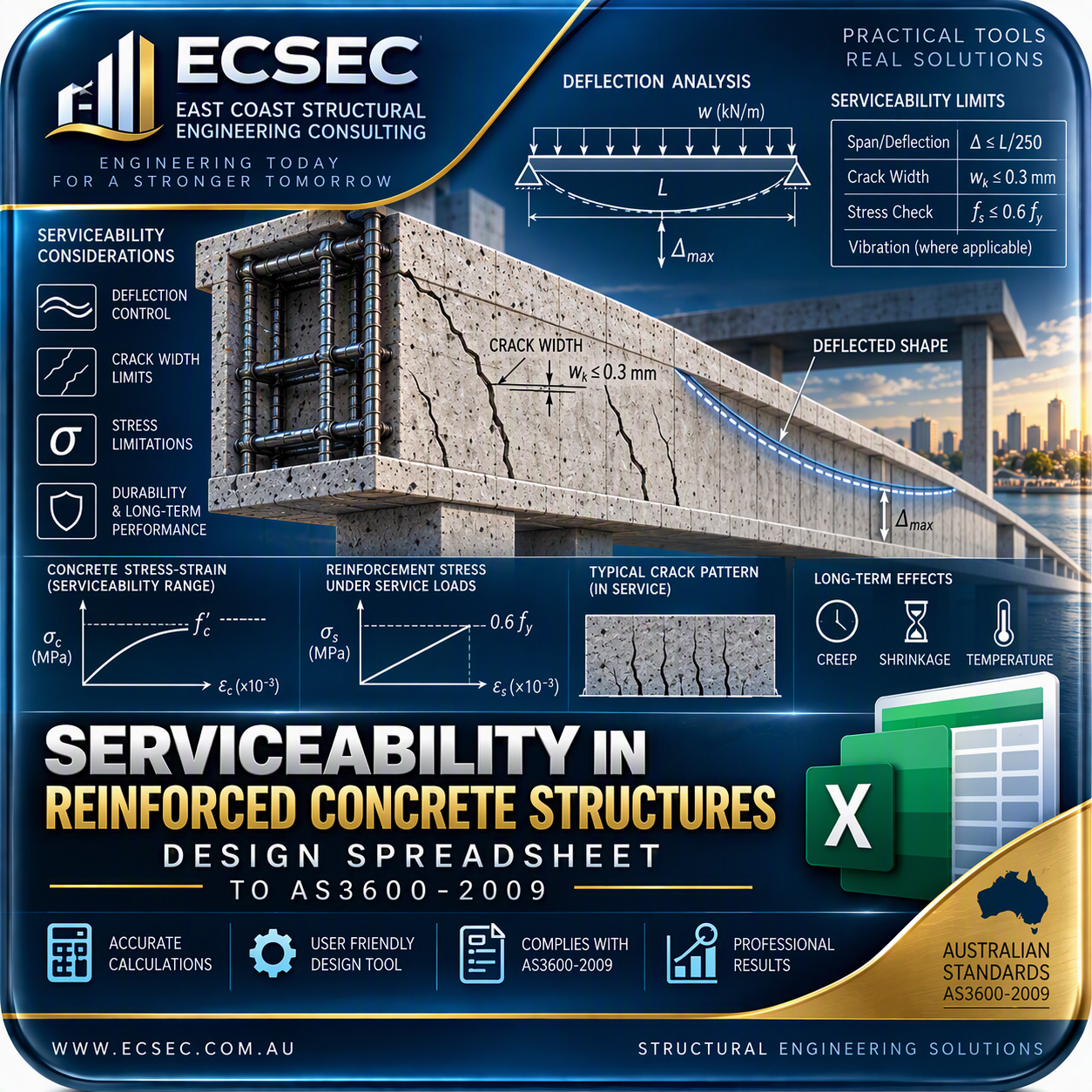
This excel focuses on ensuring reinforced concrete structures perform satisfactorily throughout their service life. The Excel spreadsheets automate the assessment of deflection, cracking, stress limits, and long-term structural behaviour, helping engineers verify that structures remain functional, durable, and aesthetically acceptable under normal operating conditions.
✅ Immediate deflection calculations
✅ Long-term deflection due to creep and shrinkage
✅ Effective moment of inertia calculations
✅ Cracked section properties
✅ Short-term beam and slab deflections
✅ Long-term beam and slab deflections
✅ Crack width assessment
✅ Minimum reinforcement for crack control
✅ Service stress calculations in concrete
✅ Service stress calculations in reinforcing steel
✅ Tension stiffening effects
✅ Span-to-depth ratio checks
✅ Deflection limit verification
✅ Serviceability limit state combinations
✅ Worked examples for beams and slabs
✅ Step-by-step examples
Learn how to evaluate the performance of reinforced concrete structures under everyday loading conditions using this collection of automated Excel spreadsheets.
While strength design ensures structural safety, serviceability design ensures a structure remains functional, comfortable, durable, and visually acceptable throughout its design life. This workbook chapter provides practical tools to assess deflections, crack control, stresses, and long-term behaviour, helping engineers meet serviceability requirements efficiently and accurately.
The spreadsheets automate calculations that are traditionally time-consuming, allowing users to quickly investigate the effects of loading, reinforcement, member size, creep, shrinkage, and cracking on structural performance.
Understand serviceability requirements in reinforced concrete design
Calculate immediate and long-term deflections
Evaluate the effects of creep and shrinkage
Assess cracking behaviour and crack control requirements
Determine cracked section properties
Verify stress limits in concrete and reinforcement
Check compliance with serviceability criteria
Improve design efficiency through automated calculations
✔ Fully automated Excel calculations
✔ Transparent formulas for learning and verification
✔ Editable spreadsheet inputs
✔ Step-by-step worked examples
✔ Suitable for university study and professional engineering practice
✔ Consistent with AS 3600 design principles
✔ Developed by ECSEC Structural Engineering Consultants
Structural Engineering Students
Graduate Structural Engineers
Design Engineers
Consulting Structural Engineers
Engineers designing concrete buildings, slabs, and infrastructure projects
Many reinforced concrete structures satisfy strength requirements but fail serviceability requirements due to excessive deflection, cracking, vibration, or long-term deformation. Understanding serviceability behaviour is essential for designing economical structures that remain durable, functional, and visually acceptable over their entire service life.
Transform complex serviceability calculations into practical engineering solutions with professionally developed ECSEC Excel tools and gain confidence in the long-term performance of reinforced concrete structures.
This excel focuses on ensuring reinforced concrete structures perform satisfactorily throughout their service life. The Excel spreadsheets automate the assessment of deflection, cracking, stress limits, and long-term structural behaviour, helping engineers verify that structures remain functional, durable, and aesthetically acceptable under normal operating conditions.
✅ Immediate deflection calculations
✅ Long-term deflection due to creep and shrinkage
✅ Effective moment of inertia calculations
✅ Cracked section properties
✅ Short-term beam and slab deflections
✅ Long-term beam and slab deflections
✅ Crack width assessment
✅ Minimum reinforcement for crack control
✅ Service stress calculations in concrete
✅ Service stress calculations in reinforcing steel
✅ Tension stiffening effects
✅ Span-to-depth ratio checks
✅ Deflection limit verification
✅ Serviceability limit state combinations
✅ Worked examples for beams and slabs
✅ Step-by-step examples
Learn how to evaluate the performance of reinforced concrete structures under everyday loading conditions using this collection of automated Excel spreadsheets.
While strength design ensures structural safety, serviceability design ensures a structure remains functional, comfortable, durable, and visually acceptable throughout its design life. This workbook chapter provides practical tools to assess deflections, crack control, stresses, and long-term behaviour, helping engineers meet serviceability requirements efficiently and accurately.
The spreadsheets automate calculations that are traditionally time-consuming, allowing users to quickly investigate the effects of loading, reinforcement, member size, creep, shrinkage, and cracking on structural performance.
Understand serviceability requirements in reinforced concrete design
Calculate immediate and long-term deflections
Evaluate the effects of creep and shrinkage
Assess cracking behaviour and crack control requirements
Determine cracked section properties
Verify stress limits in concrete and reinforcement
Check compliance with serviceability criteria
Improve design efficiency through automated calculations
✔ Fully automated Excel calculations
✔ Transparent formulas for learning and verification
✔ Editable spreadsheet inputs
✔ Step-by-step worked examples
✔ Suitable for university study and professional engineering practice
✔ Consistent with AS 3600 design principles
✔ Developed by ECSEC Structural Engineering Consultants
Structural Engineering Students
Graduate Structural Engineers
Design Engineers
Consulting Structural Engineers
Engineers designing concrete buildings, slabs, and infrastructure projects
Many reinforced concrete structures satisfy strength requirements but fail serviceability requirements due to excessive deflection, cracking, vibration, or long-term deformation. Understanding serviceability behaviour is essential for designing economical structures that remain durable, functional, and visually acceptable over their entire service life.
Transform complex serviceability calculations into practical engineering solutions with professionally developed ECSEC Excel tools and gain confidence in the long-term performance of reinforced concrete structures.