This ECSEC package brings together programmed examples covering materials technology, structural loading, flexural strength, shear and torsion, serviceability, beam and slab design, and reinforced concrete columns.
Establish a strong foundation in concrete technology, material behaviour and structural loading. The programmed examples help users calculate key concrete properties, evaluate early-age behaviour and determine design actions for strength and serviceability conditions.
Your validated Chapter 1 workbook includes examples for water-cement ratio, water-reducing admixture, target mean strength, carbonation depth, bleed-water evaporation, thermal cracking, strength and serviceability load combinations, beam design loads and fire-resistance levels.
Example calculations include:
Water-cement ratio
Concrete target mean strength
Concrete admixture requirements
Carbonation depth
Bleed-water evaporation and plastic-shrinkage risk
Temperature rise and thermal-cracking assessment
Strength design actions
Short-term and long-term serviceability actions
Beam load calculations
Positive and negative design actions
Fire-resistance level assessment
Develop a practical understanding of how reinforced concrete sections resist bending. The spreadsheets automate important flexural-analysis calculations and help users investigate the relationship between concrete compression, reinforcement tension, neutral-axis depth and section capacity.
Example calculations may include:
Rectangular stress-block parameters
Neutral-axis depth
Internal force equilibrium
Singly reinforced sections
Doubly reinforced sections
Tensile and compression reinforcement
Reinforcement ratios
Ultimate moment capacity
Strength-reduction factors
Under-reinforced and over-reinforced behaviour
Section-capacity verification
Analyse reinforced concrete members subjected to shear forces and torsional moments. The spreadsheets simplify the calculation of shear resistance, transverse reinforcement, torsional capacity and reinforcement requirements.
Example calculations may include:
Concrete contribution to shear strength
Ultimate shear capacity
Minimum shear reinforcement
Stirrup size and spacing
Maximum shear capacity
Torsional cracking assessment
Torsional strength
Closed-stirrup reinforcement
Longitudinal torsional reinforcement
Combined shear and torsion checks
Beam section verification
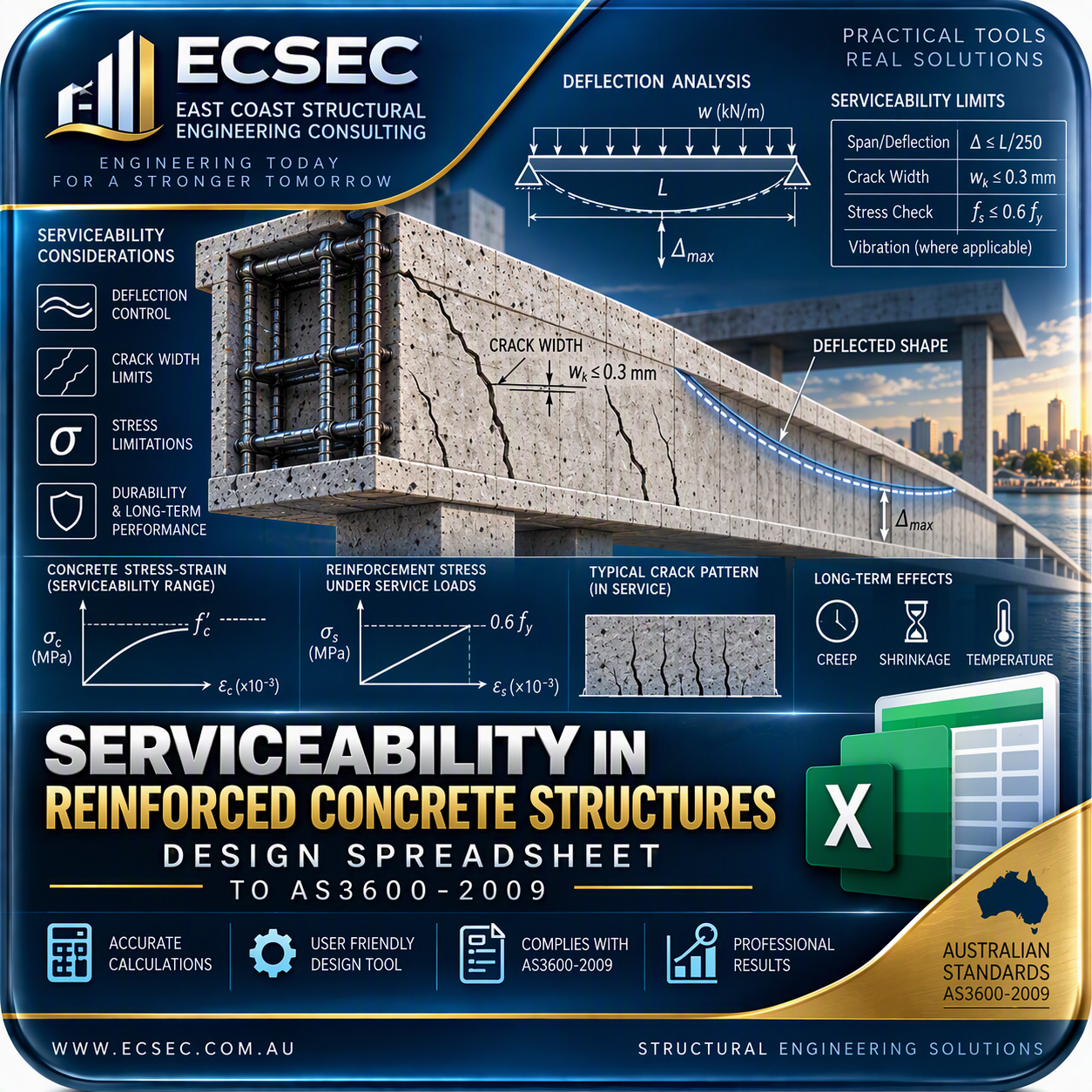
Assess the behaviour of reinforced concrete members under normal service conditions. These Excel tools assist with deflection, cracking and long-term behaviour calculations, helping users understand how a structurally adequate member can also satisfy functional and durability requirements.
Example calculations may include:
Uncracked and cracked section properties
Effective moment of inertia
Immediate deflection
Long-term deflection
Creep and shrinkage effects
Tension-stiffening effects
Crack-control requirements
Minimum reinforcement
Service stress calculations
Span-to-depth assessments
Serviceability-limit verification
Beam and slab deflection examples
Apply flexural-strength principles to the practical design of reinforced concrete beams and slabs. The spreadsheets automate reinforcement calculations and capacity checks for structural elements commonly used in building projects.
Example calculations may include:
Singly reinforced beam design
Doubly reinforced beam design
Rectangular and flanged sections
Required tensile reinforcement
Compression reinforcement
Reinforcement bar selection
Ultimate moment-capacity verification
One-way slab design
Continuous beam and slab design
Positive and negative moment reinforcement
Minimum and maximum reinforcement checks
Practical reinforcement arrangement
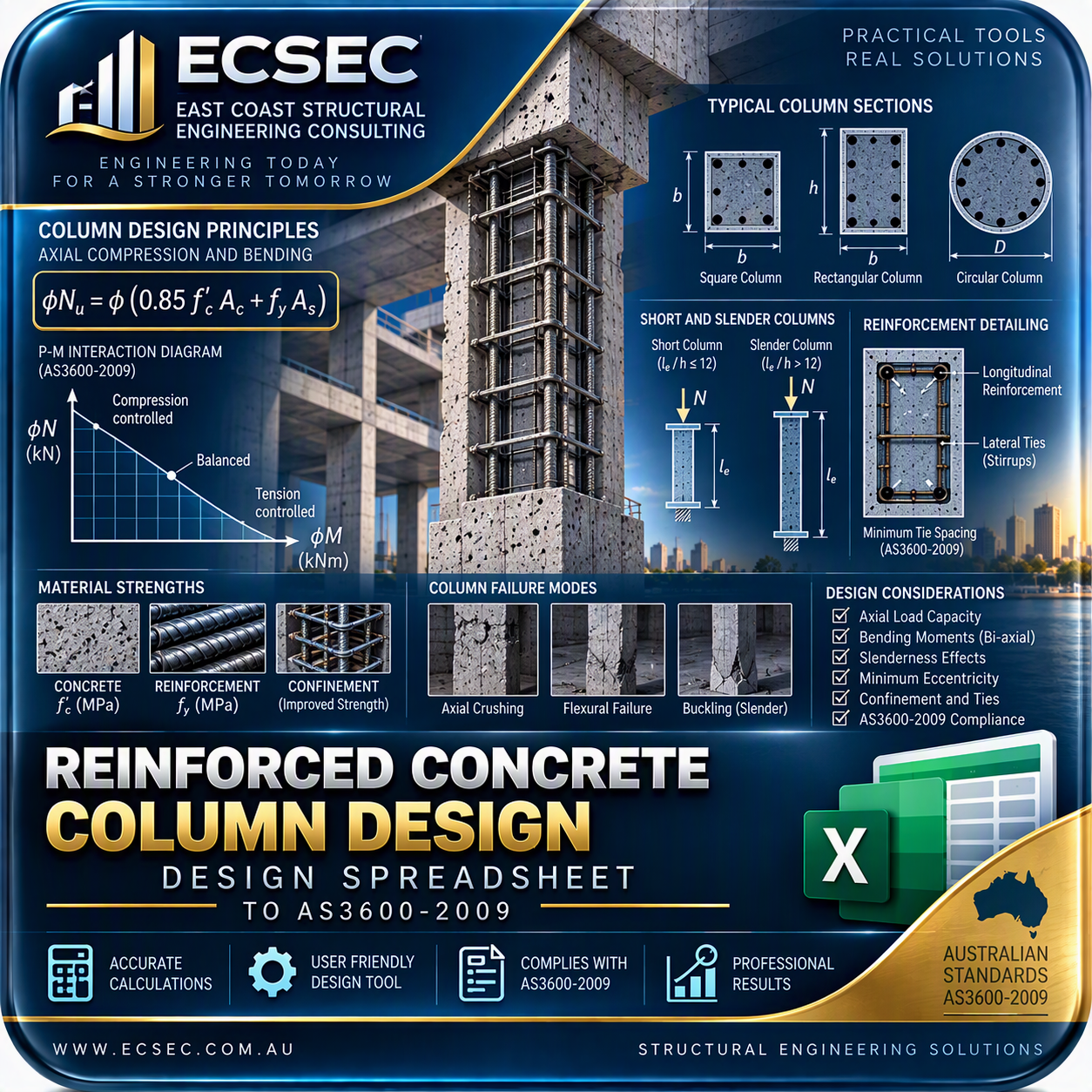
Analyse and design reinforced concrete columns subjected to axial compression and bending moments. The programmed examples provide practical tools for evaluating column capacity, reinforcement requirements and the interaction between axial loads and flexural actions.
Example calculations may include:
Axially loaded columns
Short-column capacity
Combined axial load and uniaxial bending
Combined axial load and biaxial bending
Moment-axial force interaction
Rectangular column design
Circular column design
Longitudinal reinforcement requirements
Tie and restraint requirements
Slenderness assessment
Second-order effects
Column capacity verification
Interpretation of column design charts
This is an independently developed Excel workbook package intended to complement the user’s own legally obtained copy of the textbook. It is not the textbook, does not reproduce the book, and is not a substitute for applicable Australian Standards, project-specific engineering assessment or independent design verification.
Bring reinforced concrete theory and practical calculation together with ECSEC’s complete Excel workbook package.
This ECSEC package brings together programmed examples covering materials technology, structural loading, flexural strength, shear and torsion, serviceability, beam and slab design, and reinforced concrete columns.
Establish a strong foundation in concrete technology, material behaviour and structural loading. The programmed examples help users calculate key concrete properties, evaluate early-age behaviour and determine design actions for strength and serviceability conditions.
Your validated Chapter 1 workbook includes examples for water-cement ratio, water-reducing admixture, target mean strength, carbonation depth, bleed-water evaporation, thermal cracking, strength and serviceability load combinations, beam design loads and fire-resistance levels.
Example calculations include:
Water-cement ratio
Concrete target mean strength
Concrete admixture requirements
Carbonation depth
Bleed-water evaporation and plastic-shrinkage risk
Temperature rise and thermal-cracking assessment
Strength design actions
Short-term and long-term serviceability actions
Beam load calculations
Positive and negative design actions
Fire-resistance level assessment
Develop a practical understanding of how reinforced concrete sections resist bending. The spreadsheets automate important flexural-analysis calculations and help users investigate the relationship between concrete compression, reinforcement tension, neutral-axis depth and section capacity.
Example calculations may include:
Rectangular stress-block parameters
Neutral-axis depth
Internal force equilibrium
Singly reinforced sections
Doubly reinforced sections
Tensile and compression reinforcement
Reinforcement ratios
Ultimate moment capacity
Strength-reduction factors
Under-reinforced and over-reinforced behaviour
Section-capacity verification
Analyse reinforced concrete members subjected to shear forces and torsional moments. The spreadsheets simplify the calculation of shear resistance, transverse reinforcement, torsional capacity and reinforcement requirements.
Example calculations may include:
Concrete contribution to shear strength
Ultimate shear capacity
Minimum shear reinforcement
Stirrup size and spacing
Maximum shear capacity
Torsional cracking assessment
Torsional strength
Closed-stirrup reinforcement
Longitudinal torsional reinforcement
Combined shear and torsion checks
Beam section verification
Assess the behaviour of reinforced concrete members under normal service conditions. These Excel tools assist with deflection, cracking and long-term behaviour calculations, helping users understand how a structurally adequate member can also satisfy functional and durability requirements.
Example calculations may include:
Uncracked and cracked section properties
Effective moment of inertia
Immediate deflection
Long-term deflection
Creep and shrinkage effects
Tension-stiffening effects
Crack-control requirements
Minimum reinforcement
Service stress calculations
Span-to-depth assessments
Serviceability-limit verification
Beam and slab deflection examples
Apply flexural-strength principles to the practical design of reinforced concrete beams and slabs. The spreadsheets automate reinforcement calculations and capacity checks for structural elements commonly used in building projects.
Example calculations may include:
Singly reinforced beam design
Doubly reinforced beam design
Rectangular and flanged sections
Required tensile reinforcement
Compression reinforcement
Reinforcement bar selection
Ultimate moment-capacity verification
One-way slab design
Continuous beam and slab design
Positive and negative moment reinforcement
Minimum and maximum reinforcement checks
Practical reinforcement arrangement
Analyse and design reinforced concrete columns subjected to axial compression and bending moments. The programmed examples provide practical tools for evaluating column capacity, reinforcement requirements and the interaction between axial loads and flexural actions.
Example calculations may include:
Axially loaded columns
Short-column capacity
Combined axial load and uniaxial bending
Combined axial load and biaxial bending
Moment-axial force interaction
Rectangular column design
Circular column design
Longitudinal reinforcement requirements
Tie and restraint requirements
Slenderness assessment
Second-order effects
Column capacity verification
Interpretation of column design charts
This is an independently developed Excel workbook package intended to complement the user’s own legally obtained copy of the textbook. It is not the textbook, does not reproduce the book, and is not a substitute for applicable Australian Standards, project-specific engineering assessment or independent design verification.
Bring reinforced concrete theory and practical calculation together with ECSEC’s complete Excel workbook package.